Feature
A character your audience recognises in shot four is not a prompt you retyped carefully. It is a reference the production holds on to. cutipAI keeps characters as reusable parts of the project, so every generated shot draws from the same source.
Every generation starts from nothing. Ask for a woman in her thirties, dark coat, tired eyes twice and you get two different women who both match the description — the sentence was never precise enough to name a person, and no number of adjectives makes it precise enough. That is survivable in a single clip and fatal in a film, because an audience reads a changed face as a changed character.
The usual workaround is a folder of stills and a best one pasted into every prompt. It half works, and it fails in the way that costs the most: the reference you reach for in shot twelve is a frame generated from the reference you used in shot three, which came from the one before it. Drift compounds, and the further into a production you are, the more expensive it is to go back.
A character in cutipAI is an entity in the project, not a paragraph you re-type. You build it once from reference images and a description, generate a character sheet that fixes the face and the look, and from then on the character is something you attach to a shot rather than something you describe again.
Because the character belongs to the project rather than to a single generation, every shot that uses it starts from the same source instead of from the previous shot’s output. The reference does not decay as the production gets longer, which is the whole reason it exists.
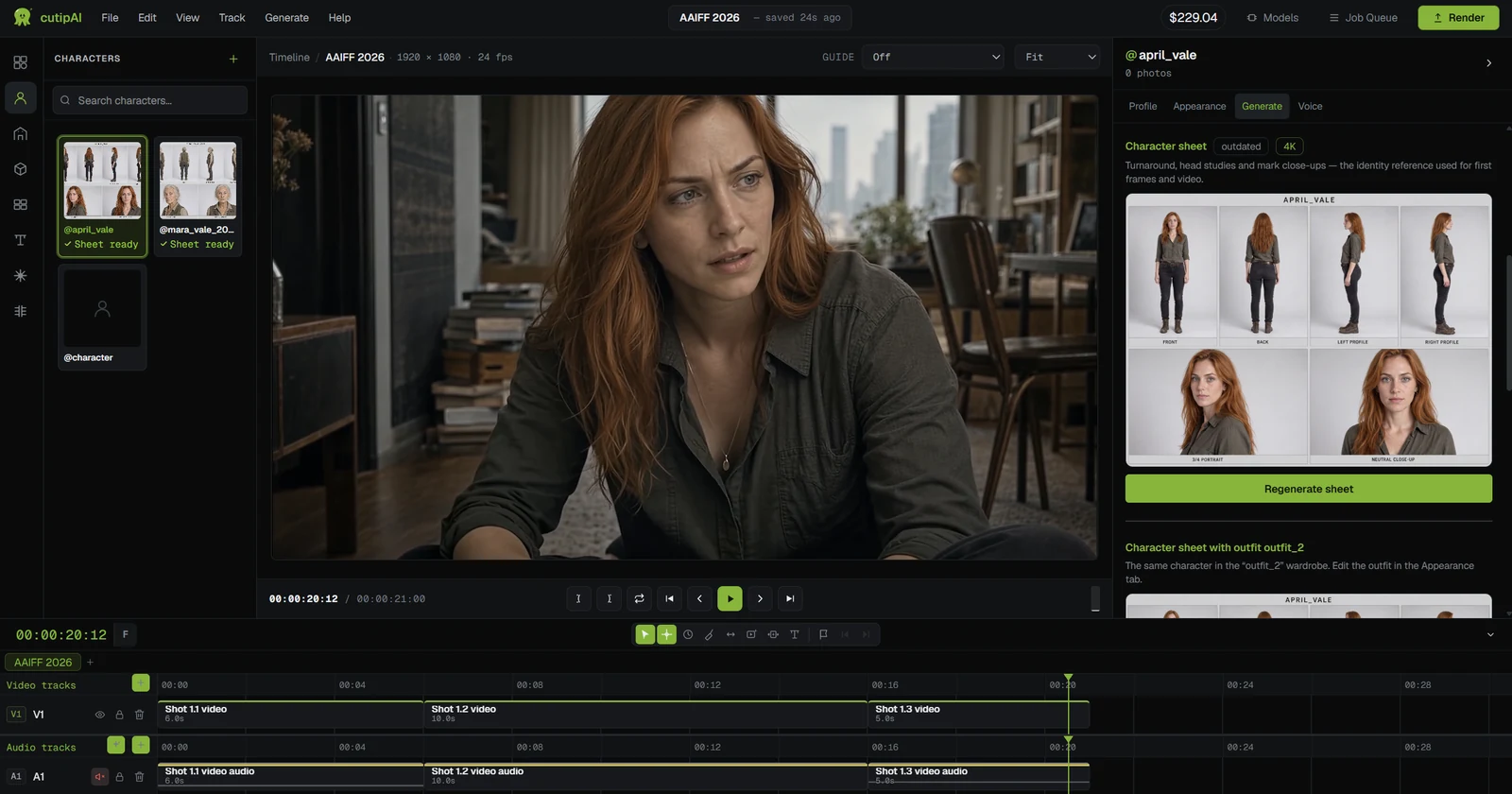
A single front-on photograph says nothing about a profile. The character sheet builds an angle set, so a shot that needs a three-quarter turn or a rear view is working from something rather than guessing.
The clothing, the body and the look that make a character recognisable at a distance live with the character. Change them in one place and the change is available to every shot you generate next.
Characters are addressed by name across the storyboard and the shot list, which is what lets a scene say who is in it without restating who they are.
Spaces and objects work the same way. A location you can shoot from several angles and a prop that keeps its own detail are the other two thirds of continuity, built with the same mechanism.
Consistency is worth its setup in proportion to how many shots share a subject. A single hero clip does not need it. A sixty-second commercial with a presenter in eight shots needs it in every one of them, and a narrative short with a recurring cast needs it across scenes that may be generated days apart.
It also changes what a failed shot costs. When the character is a reference rather than a prompt, regenerating one shot does not risk pulling the rest of the film out of alignment — you are changing the shot, not the person in it. That is the same argument as planning the shot list first: both are ways of not paying twice for the same decision.
No, and nothing available today does. Generation is probabilistic, so a reference raises the floor and narrows the variation rather than removing it — which is why the character sheet is built from several angles, and why a shot you are not happy with can be regenerated against the same source rather than re-described.
You are responsible for the rights to any image you bring into a project, a likeness included. Reference images you import from your own machine stay on it; cutipAI does not upload your local media.
Shots you have already generated keep the frames you generated. The change applies to what you generate next, so a wardrobe fix late in a production is a decision about which shots to re-run rather than an automatic rewrite of the film.
Building a character runs generations like any other work, and each one shows an estimated cost before it runs. There is no subscription and no separate fee for keeping a character in a project.
Start a project, build the characters, spaces and objects it needs, and let every shot you generate afterwards draw from them.